Team-Deck
Live →Question cards to open a meeting: share your screen, pick a deck, draw a card. No sign-in and no cookies.
Many meetings open with a round: how are you, what did you do at the weekend? After a few weeks it is always the same question, and the answers get shorter. Team-Deck puts question cards on the table, so whoever runs the meeting does not have to come up with something new every time. My team now starts its meetings with it.
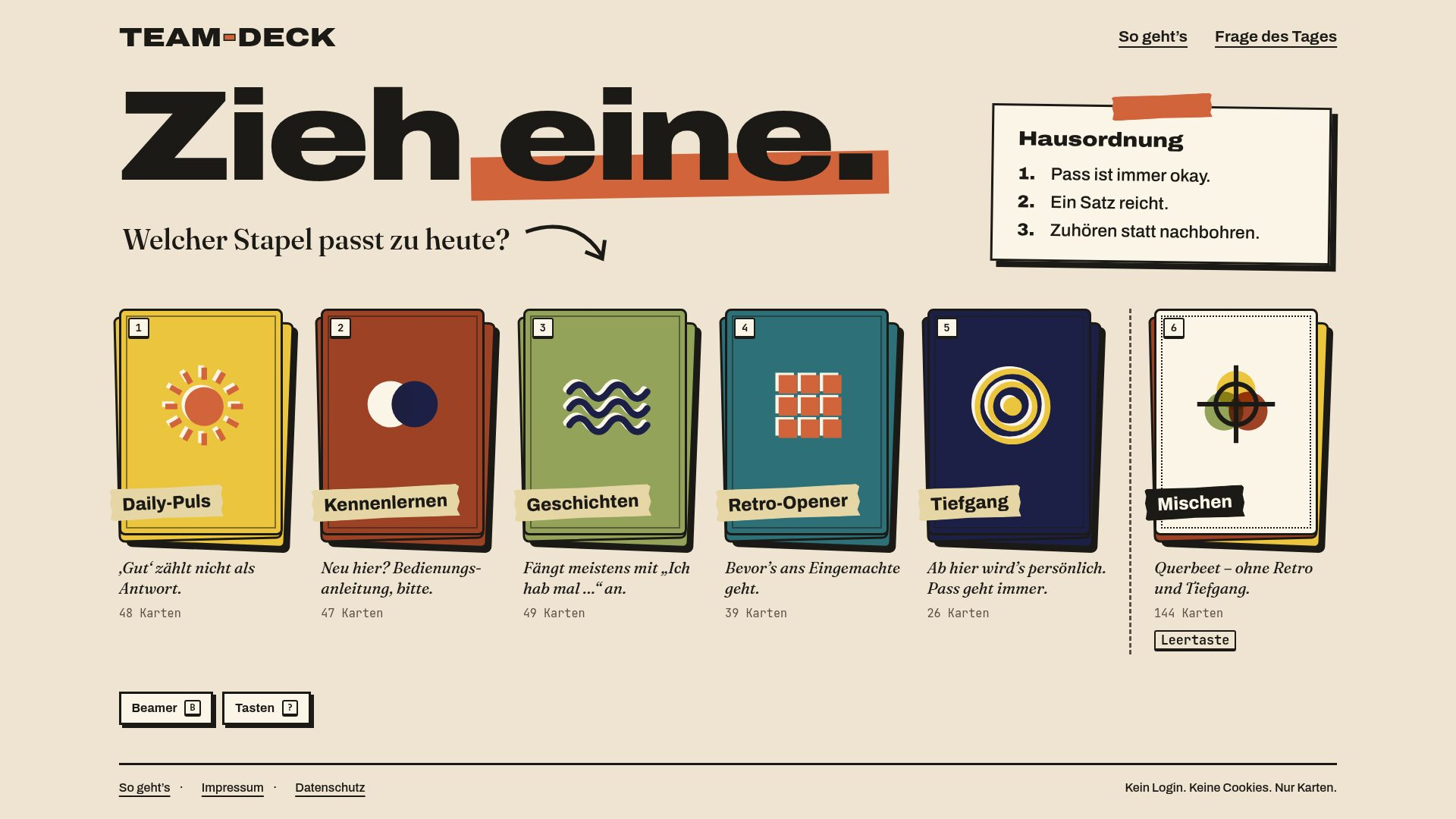
The decks are sorted by occasion: a daily pulse for a quick check of the mood, getting-to-know-you cards for new people on the team, stories for small anecdotes, plus retro openers and deep questions. Pass and “another question” sit right next to “next” as equals, because nobody should have to answer. For a shared screen there is a timer, a projector mode and keyboard shortcuts for everything; every card has its own link, and the question of the day is the same for everyone.
The first version came about in January 2026, with just over three hundred questions in categories tucked away behind a drop-down menu. Then it sat untouched. This autumn I brought it back out and rebuilt it to look like a screen print, and gave the questions a thorough clear-out: plenty of “What is your favourite …” went, and just over two hundred stayed.
Decisions
Remember nothing
There is no sign-in, no cookies, and nothing is stored in the browser. Settings such as the deck, the timer or projector mode are part of the URL and can be bookmarked. That way a privacy policy of a few sentences is enough.
Deep questions only on request
The retro openers and the deep questions are left out of the shuffle and out of the question of the day. Personal questions should not land in front of a whole team unasked, and a retro needs an occasion. Anyone who wants them picks that deck on purpose.
Links that last
Every question has a fixed identifier, because shared cards stay in team chats and should still show the same question months later. A test makes sure no identifier appears twice. The question of the day needs no storage: it is calculated from the date, so everyone sees the same one on the same day.